About The Song
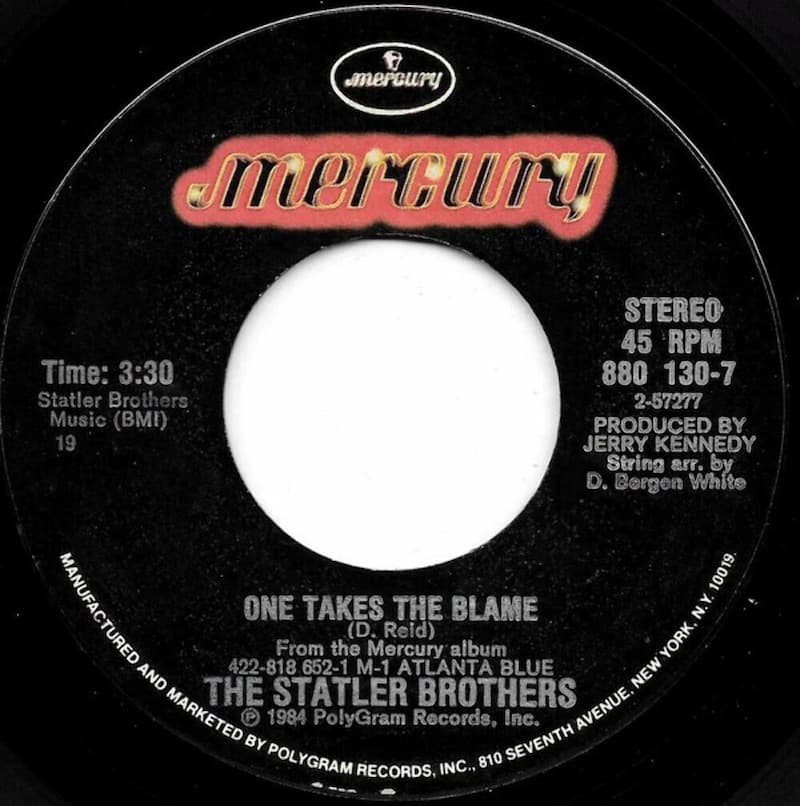
When “One Takes the Blame” arrived on country radio in July 1984, it sounded like The Statler Brothers doing what they did best: turning a small domestic moment into a three-and-a-half-minute record that listeners could recognize instantly. Released by Mercury Nashville as the second single from the album Atlanta Blue, the song was written by Don Reid and produced by Jerry Kennedy, with “Give It Your Best” placed on the B-side of the 45.
Atlanta Blue had come out earlier in 1984 and quickly set the tone for the group’s mid-’80s run on Mercury, where they were still landing major singles after more than a decade of hits. The title track had already peaked at No. 3 on Billboard’s country chart, and the label followed it with “One Takes the Blame” as a steadier, relationship-centered record—less “big statement,” more “two people behind a closed door.”
That kind of writing sits right in Don Reid’s lane. Beyond being the Statlers’ lead singer, he served as the group’s principal songwriter for years, building a catalog that leaned on everyday language and clear scenes rather than flashy metaphors. In later biographies and interviews about his songwriting life, Reid has described himself first as a storyteller—someone interested in the details people remember, and the sentences they actually say when emotions are running high.
The song’s premise is simple but specific: when an argument has gone too far, somebody has to stop the spiral. Instead of trying to “win,” the narrator chooses the shortcut back to peace—taking the blame, even if the truth is more complicated. That idea is familiar in country music, but the Statlers’ version works because it feels like a conversation you’ve overheard, not a sermon. It’s an apology that knows it’s strategic.
It also arrives during the Jimmy Fortune era of the group, after he joined in 1982–83. The Statlers’ signature has always been the blend—Don Reid on lead lines, Harold Reid anchoring the bottom, Phil Balsley filling the middle, and Fortune adding a brighter top. On “One Takes the Blame,” that blend turns a private admission into something communal, like the group is backing the narrator’s decision in real time.
Commercially, the record performed exactly like a strong second single should. “One Takes the Blame” peaked at No. 8 on Billboard’s Hot Country Singles chart in 1984 (and reached No. 20 on Canada’s RPM country chart), keeping the Atlanta Blue cycle firmly in the Top 10 conversation. Billboard’s own Statler Brothers chart recap later listed it among the group’s biggest country hits.
In retrospect, the song fits neatly into a three-single story arc from Atlanta Blue: a city-tinted title track, this relationship truce, and then “My Only Love,” which went on to hit No. 1 later in 1984. “One Takes the Blame” may not be their most famous title, but it’s a clear snapshot of why the Statlers lasted—tight vocal identity, a producer who understood them, and Don Reid’s habit of finding drama in the ordinary.
Video
https://www.youtube.com/watch?v=2NbjETpi440
Lyric
When it’s over, ‘n’ God knows as well as we it is
When we pack up, ‘n’ stack up what’s hers and what’s his
When we make up the stories to cover up the shame
They never will believe we simply fell out of love
So one takes the bow, one takes the blame
It won’t be easy to throw away so many years and smile
But don’t feel guilty, we gave it our best for a while
But the story we tell our friends must always be the same
‘Cause they never would believe it was really no one’s fault
One takes the bow, one takes the blame
One takes the bow, one takes the blame
That’s the way you have to play the game
Your friends need someone they can talk about and blame
And God forbid that my friends need the same, ain’t that a shame?
When we get lonely, and lonely we’ll get now and then
Just remember that somewhere we both still have a friend
Love’s not forever and ours went as gently as it came
So for all the years I loved you, and you know I really loved you
You take the bow and I’ll take the blame
You take the bow and I’ll take the blame