About The Song
“Hello Mary Lou” started life long before The Statler Brothers ever stepped into a studio with it. The song is credited to Gene Pitney and Cayet Mangiaracina, and it first appeared on record in 1960. A year later it became a rock-and-roll staple when Ricky Nelson cut it at United Western Recorders and released it in May 1961 as the flip side to “Travelin’ Man,” a pairing that still shows how tightly early-’60s singles were built for radio impact.
Pitney’s connection is part of the reason the tune kept traveling across decades. Before he was widely known as a solo artist, he had already built a reputation as a songwriter—“Hello Mary Lou” is regularly cited among the early hits that put his name in the business. That background helps explain why the song’s structure is so durable: it’s concise, melodic, and easy to reshape without losing its identity, whether the singer leans toward teen-pop, rockabilly, or country.
Nelson’s 1961 recording is the version most listeners recognize as the standard reference point. It reached the Top 10 on the U.S. charts (while “Travelin’ Man” went to No. 1), and it performed strongly overseas as well. Those chart facts mattered later, because by the time country artists revived the song, they weren’t digging up an obscure deep cut—they were reintroducing a proven hit with instant recognition built in.
That’s the context for The Statler Brothers’ decision to record it in the mid-1980s. By then, they were a veteran group with a long streak of country success, and they typically leaned on contemporary country material rather than old pop/rock standards. Covering “Hello Mary Lou” was unusual for their later era, which is exactly what made it stand out: it let them plug their signature blend and phrasing into a familiar melody and make it sound like a Statlers record rather than a nostalgia exercise.
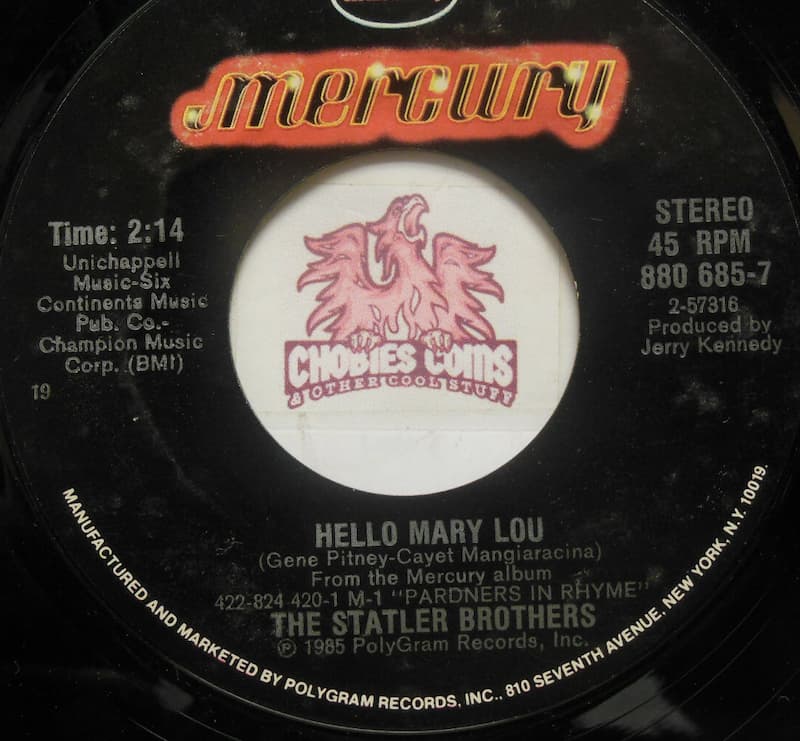
Their version was released in 1985 on the Mercury album Pardners in Rhyme, produced by longtime Nashville hitmaker Jerry Kennedy. The album itself was a major commercial moment—going to No. 1 on Billboard’s Top Country Albums chart—so the cover landed inside a project that already had momentum. As a single, “Hello Mary Lou” became one of their biggest hits of the decade, reaching No. 3 on Billboard’s Hot Country Songs chart.
Part of what worked was how the group approached the performance. The Statlers didn’t try to out-rock the rockabilly feel; they pulled the song toward straight country timing and let the vocal stack do the heavy lifting, including Harold Reid’s low harmony anchoring the blend. That choice kept the tune’s forward motion while making room for the group’s defining “four voices, one sound” identity that fans expected.
In hindsight, the record functions like a bridge: a 1961 classic written by a future pop star and cemented by a teen idol, then repurposed by a country institution more than twenty years later—without needing a rewrite to make it feel current for its moment. The Statlers’ 1985 hit didn’t replace the original; it proved the song could live comfortably in another genre, another format, and another era of radio.
Video
Lyric
Passed me by one summer day
Flashed those big brown eyes my way
And, oh, I wanted you forever more
Now I’m not one that gets around
Swear my feet stuck to the ground
And though I never did need you before
I said, “Hello Mary Lou” goodbye heart
Goodbye heart
Sweet Mary Lou, I’m so in love with you
I’m in love with Mary Lou
I knew, Mary Lou, that we, we’d never part
So hello Mary Lou, goodbye heart
I saw your lips, I heard your voice
Believe me, I just had no choice
Wild horses couldn’t make me stay away
I thought about a moonlit night
Arms around you good and tight
And that’s all I need to see for me to say
I said, “Hello Mary Lou” goodbye heart
Goodbye heart
Sweet Mary Lou, I’m so in love with you
I’m in love with Mary Lou
I knew, Mary Lou, that we, we’d never part
So hello Mary Lou, goodbye heart
I said, “Hello Mary Lou” goodbye heart
Goodbye heart
Sweet Mary Lou, I’m so in love with you
I’m in love with Mary Lou
I knew, Mary Lou, that we, we’d never part
So hello Mary Lou, goodbye heart
So hello Mary Lou, goodbye heart